Sending unsold books back to a publisher without losing track of the claim
A box of books going back to a publisher is money you are owed until their credit note arrives. How BooksPOS records a publisher return as a claim, settles it with the credit note, and handles a shortfall.
After the school season, most book depots send unsold copies back to their publishers and distributors. The books leave the shop on one day; the credit note arrives weeks later, sometimes for less than you expected. In between, that return is money you are owed, and if it lives only in a register or someone's memory, it is easy to lose.
BooksPOS records a publisher return as what it is: stock leaving the shop, and a claim on the supplier that stays open until their credit note settles it.
1. Send the books back
On the store PC, open Publisher returns and start a return to the supplier. Add the items and quantities going back, and mark each as sellable or damaged.
When you post the return:
- the copies leave your stock at their average cost;
- the supplier now owes you a claim at the net price you last paid them for those items;
- any difference between the two is recorded in the accounts, so the books still balance.
2. The return window
Many publishers only take books back within a set time after delivery. Each supplier in BooksPOS can have a return window. BooksPOS checks each return against the supplier's last delivery; past the window, a manager must give a reason before the return can be posted. The reason is kept with the return.
3. Settle the claim with the credit note
When the publisher's credit note arrives, open the return and choose Record credit note. The credit note settles the claim and reduces what you owe that supplier.
If the credit note is for less than the claim, the shortfall can be written off with a reason, so the difference is visible instead of disappearing into a rounding.
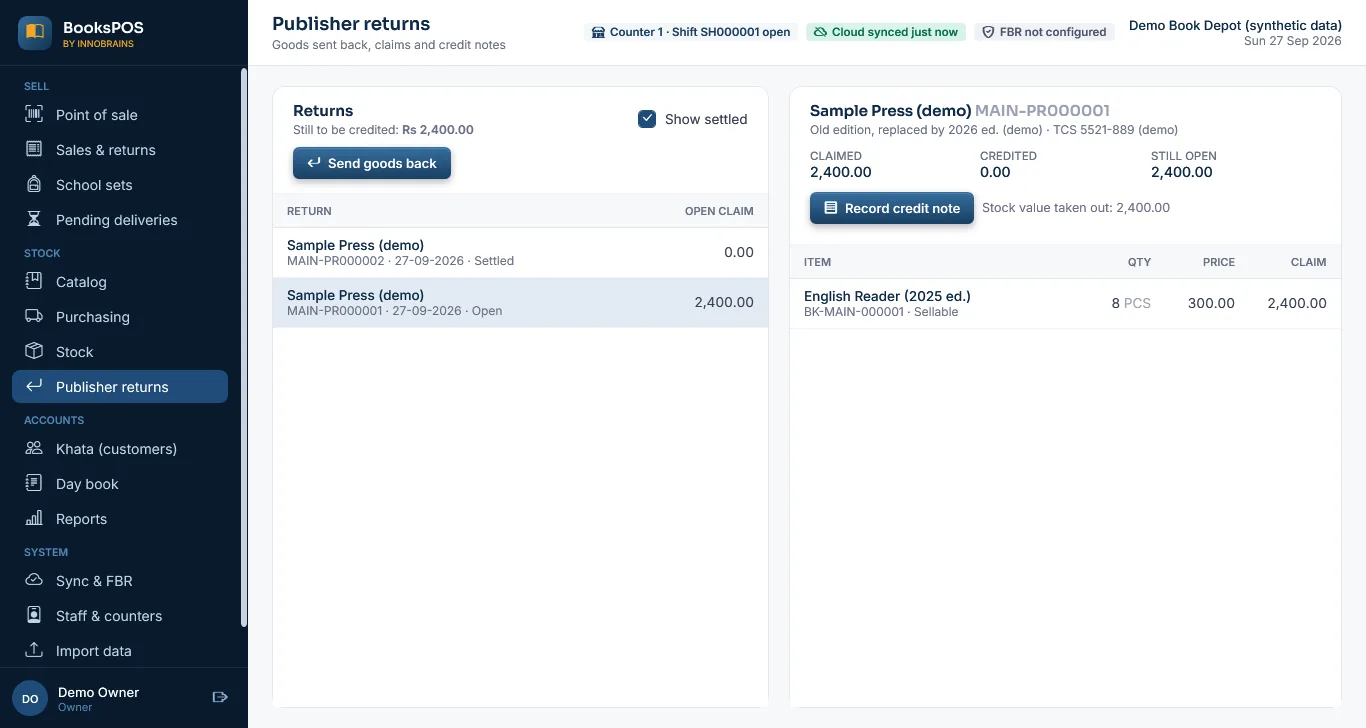
One return settled, one claim still open. Screenshot of the current build (26 Sep 2026), synthetic demo data.
4. Books on sale or return
Some publishers leave copies on sale or return (consignment). Those copies are different: they are not yours until you sell or keep them. BooksPOS keeps them apart from your own stock (they are not in your stock value, and nothing is owed until a copy is sold or kept, at the agreed price). Unsold consigned copies go back with nothing owed. The shop's own copies are sold first. This is BooksPOS's default policy; check it against the terms your publishers actually give you.
5. Seeing where you stand
- Each supplier's statement shows what you owe them, with a running balance; a credit note reduces it.
- Supplier ageing in the owner reports shows what you owe each supplier, and for how long.
- Publisher performance shows each publisher's sell-through, margin and what was sent back, which helps decide how much to order next season.
- Old editions still in stock shows what may be worth returning before a window closes.
Before the next season
- Run the old-editions report and the publisher performance report.
- Check each publisher's return window against its last delivery.
- Post the returns before the windows close, marking damaged copies as damaged.
- Follow up open claims: the returns list shows which are still waiting for a credit note.
Common questions
At what price is a publisher return valued?
The claim is at the net price you last paid that supplier for the item. The copies leave your stock at their average cost, and any difference between the two is recorded in the accounts.
What if the credit note is less than the claim?
Record the credit note, then write off the shortfall with a reason. The shortfall stays visible in the books.
Can I return books after the publisher's deadline?
Only if a manager gives a reason. Each supplier can have a return window, checked against their last delivery.
Are sale-or-return copies part of my stock value?
No. Consigned copies stay the publisher's until sold or kept, and are owed only then, at the agreed price.
Can I see how much each publisher owes me in open claims?
Yes. Open claims are listed on the returns screen, each with its amount.
These features work in the current build and have not been used in a real shop yet. More on the book depot page and on features.
Founder & CEO, Innobrains Technologies
Arshad Ali is the founder and CEO of Innobrains Technologies, the company that is building BooksPOS: point-of-sale, stock and khata software for book depots and stationers in Pakistan.
Run your book depot on BooksPOS
Billing, editions and ISBNs, school course sets, khata and advances, on the shop's own PC without internet. In development: pilot shops set it up with us.
Related guides
ISBN check digits explained, and why a wrong ISBN is refused
The last character of every ISBN is worked out from the others. Here is how the ISBN-10 and ISBN-13 check digits are calculated, how the two forms convert, and why BooksPOS refuses a wrong ISBN instead of guessing.
27 Sep 2026 · 5 minKeeping book editions apart, so the shelf and the records agree
When a school changes the edition of a reader, the old and new copies are different stock at different prices. How BooksPOS keeps each edition as its own item, from import to the till to publisher returns.
27 Sep 2026 · 5 minSelling a school course set at the till, and ordering the missing titles
Keep each school's class list, put the whole set on the bill with one key, leave out what the parent already has, and order what is out of stock for them. A walk-through of school course sets in BooksPOS.
27 Sep 2026 · 5 min