What BooksPOS does today, and what is still planned
Every item below carries its real state. “Works today” means it is built and covered by automated tests in the current build; it has not yet been used in a real shop.
Selling at the counter
Keyboard-first till
Works todayScan a barcode or search by title, author, item code, ISBN (with or without dashes) or Urdu text. Change quantity and unit, hold a bill and pick it up later. A bill in progress survives a crash.
Payments
Works todaySplit one bill across cash, card, bank transfer, EasyPaisa and JazzCash, on account (khata) within the customer's credit limit, or from their advance. Change is worked out for you. Card and wallet payments are recorded, not verified with the provider.
Discounts with limits
Works todayA line discount above a set limit (10% by default) needs the price-override permission. Selling below cost needs authorisation.
Returns against the bill
Works todayReturn part of a bill, in another unit if needed, back to stock or marked damaged, with the refund going to the right place. You can never return more than was sold, even from two counters at once.
Counters and shifts
Works todayEach counter has its own bill numbers and cash shifts. Closing a shift is blind: the cashier counts first, then sees the difference, which is recorded.
Orders and school sets
Orders and reservations
Works todayAt the till, Order (F7) turns the bill into a customer order. Copies in stock are held for the customer until a hold date (14 days by default); the rest is awaited. Walk-in sales cannot take held copies. A lapsed hold simply stops counting.
Pending deliveries
Works todayHand over what the customer collects as a normal bill at the agreed order price, payable from their advance. "Reserve what is free" holds stock that has since arrived. Print a pending-items slip, which says it is not a bill. Cancelling what is left needs a manager.
School course sets
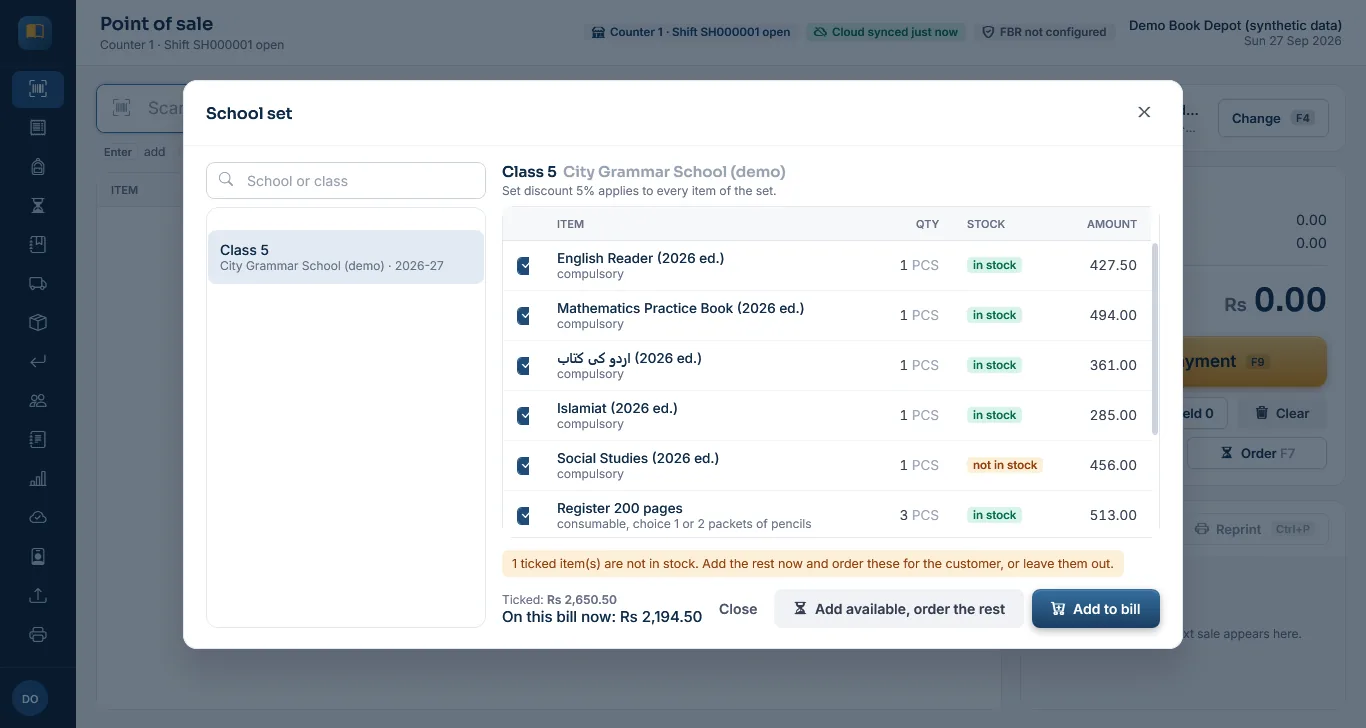
Works todaySchools and a class list per session and section. Items are compulsory, optional or consumable, with approved alternatives. Lists are versioned: a draft, then a published version that never changes.
School set at the till
Works todaySchool set (F6) adds the ticked items that are in stock and can order the rest for the customer. The set discount applies only to items added from the published list.
Next session and demand
Works todayCopying a list to the next session makes a draft that cannot go live until it is changed or its newer editions are reviewed and confirmed. A demand view per list shows sold, ordered, held, free and to buy.
Books and stationery catalogue
Editions as separate items
Works todayEach edition or format is its own item with its own stock; receiving a new edition never changes the old one's stock.
Book and stationery fields
Works todayAuthor, publisher, subject, class, board, language, year and binding for books; brand, colour, size and category for stationery. Shelf or rack for both.
ISBN without guesswork
Works todayISBN is optional. When given, its check digit is verified. Items without one get an internal code; BooksPOS never invents an ISBN.
Packs and units
Works todayPieces, packets, dozens, boxes, reams or cartons with sizes set per item, and a pack price of its own. Stock is kept in pieces, so it is never counted twice.
Several barcodes per item
Works todayPublisher barcode, your old labels and pack barcodes all scan to the right item and unit.
Dated prices
Works todayRetail and wholesale prices with their history; a price change never rewrites old bills.
Price lists, quantity breaks and promotions
Works todayNamed, dated price lists for groups of customers: their own item prices, or a discount off a publisher or a category. A lower price from a given quantity. Promotions for walk-in customers with a first and last day. One source sets each price and nothing stacks; every bill line says where its price came from.
Stock and purchasing
Purchase receipts
Works todayGoods and the supplier's bill together, with free quantity, paid now, on credit or from an advance paid to the supplier. The same supplier bill number cannot be entered twice.
Stock that cannot go negative
Works todayEvery change is a movement that is never edited. A sale that would take stock below zero is refused.
Adjustments with reasons
Works todayFound, lost or damaged stock, each with a reason and its effect in the accounts.
Publisher returns
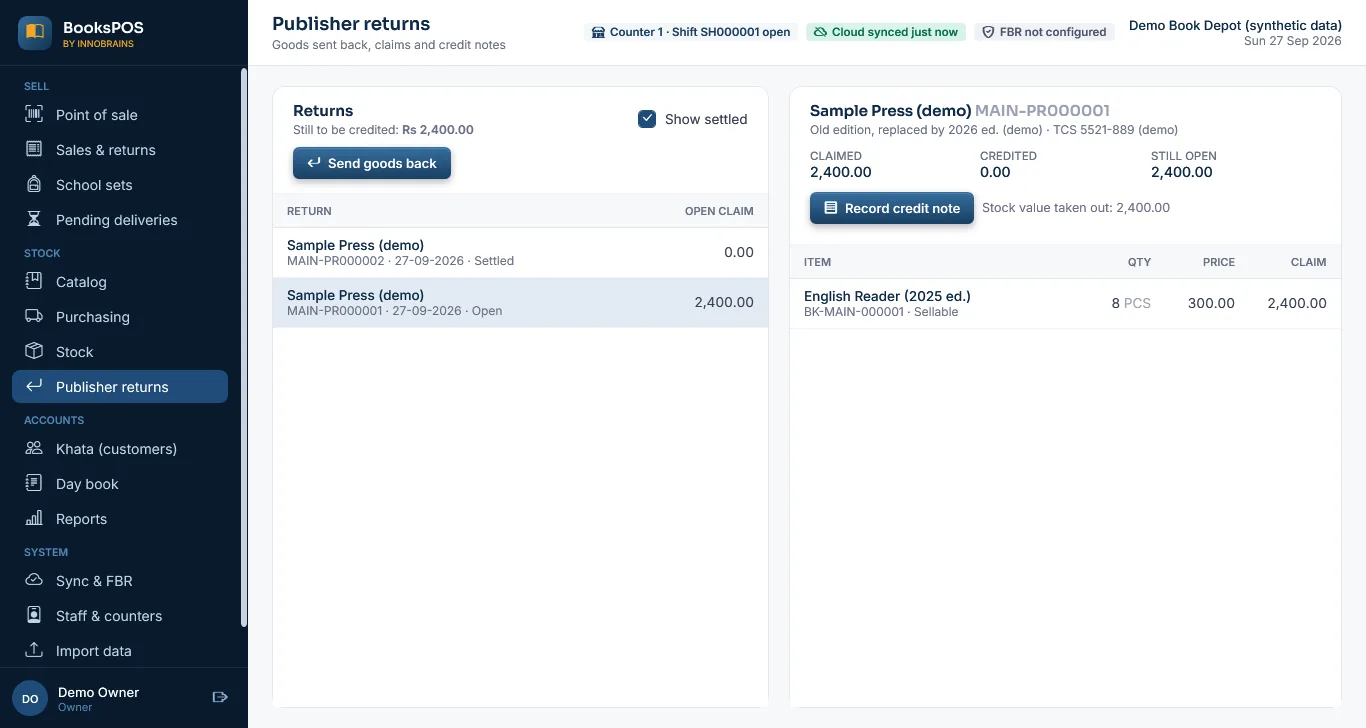
Works todayGoods sent back to a supplier become a claim at the net price last paid to them; stock leaves at average cost. The supplier's credit note settles the claim, and a shortfall can be written off with a reason. Each supplier can have a return window; a return past it needs a manager and a reason.
Purchase orders and matching
Works todayOrders to a supplier at an agreed cost, delivered in parts; each delivery is received against the order, never more than is still to come. Bills are matched against the agreed cost of the paid copies; the rest of an order can be closed with a reason.
Stock counts
Works todayCount a shelf, a class or the whole shop while it stays open. Each counted line keeps what the books said at that moment, so a copy sold afterwards does not look missing; only real differences are posted, at average cost.
Godown and transfers
Works todayKeep stock in a godown or back store and move it to the shop floor at its cost; the till sells what is on the floor, and stock reports show where every copy is.
Consignment (sale or return)
Works todayCopies a publisher leaves on sale-or-return stay theirs: not in your stock value and not owed until one is sold or kept, then owed at the agreed price. Unsold copies go back with nothing owed. The shop's own copies are sold first; how this matches your publishers' terms is for you to confirm.
Transfers between branches
Works todayStock sent to another branch leaves at its cost at once; the other branch counts it in, and anything short is written off there with a note. Both branches see what arrived. Tested with two store servers on one PC, not yet between two shops.
Accounts
Khata for customers
Works todayCredit limits, balances, statements, and payments received in cash (through the drawer), bank, card or wallet.
Customer advances
Works todayMoney a parent pays ahead is held for them, used later on bills, and refundable. It is never counted as a sale or as extra cash.
Suppliers
Works todayPayments, advances paid ahead of their bill, and statements for what the shop owes.
Double-entry day book
Works todayEvery posting is a balanced journal entry. Day book, trial balance and a daily sales report with cost of goods sold.
Expenses and the bank
Works todayRent, wages, electricity and other expenses by category, paid from the drawer, the bank or a wallet; cash taken to or from the bank. Cash always passes through a counted drawer.
Closing the books
Works todayThe owner closes the books through a past date; nothing can then be posted into it, and reopening needs a reason.
Owner reports
Works todayProfit and loss for any period, stock value by category, who owes what and for how long (customers and suppliers), publisher sell-through, old editions still in stock, and school sets still being completed.
Going live
Import from CSV
Works todayItems (with packs and opening stock), customers and suppliers (with opening balances). Match columns on screen, see every error by row number before saving, and resume after a power cut. Tested with 50,000 rows.
Opening balances
Works todayWhat customers owed and what you owed suppliers before BooksPOS, dated as of your closing day.
Shop network and cloud
Works without internet
Works todayThe shop's main PC runs the store server and keeps the database. Selling, returns, purchases and closing the day need no internet.
Tills on other PCs
Works todayOther PCs join over the shop network with a one-time code and an encrypted, pinned connection, and can be removed at once. So far tested with two tills on one PC, not yet across two physical PCs.
Sync to BooksPOS Cloud
Works todaySales and returns go up in order, each once, even after the cloud was away. Totals in the cloud were checked equal to the store's own report.
Owner portal
Works todayDaily sales per branch with the time of the last report, paired PCs, pairing codes, licence and two-step sign-in.
Licence check on the store PC
Works todayThe store PC checks the cloud's signed licence grant itself, so it works offline, and shows active, grace, ran out or suspended. Past grace, or when suspended, new sales and purchases stop; records stay readable and money owed can still be received. Turning the clock back does not extend it. Tested with the cloud on one PC. No release carries the production signing key yet, and which actions stop is still to be confirmed.
Changes from the cloud
Works todayThe owner edits an item's title, edition, category, status or prices in the portal. Each branch applies the edit at its next sync, unless someone changed that item in the shop meanwhile; then it waits for a person to choose. New items, packs and barcodes are still added in the shop.
A new branch joins from the cloud
Works todayA second shop is set up as a branch of the same business with a pairing code from the portal.
Printing
Receipts and A4 invoices
Partly built58 and 80 mm thermal receipts (with Urdu printed as an image when needed), A4 invoices, pending-items slips and a daily PDF. Tested in software; not yet printed on a real printer.
Barcode labels
Partly builtLabels on A4 sheets of 24 or a 50 × 30 mm roll: a valid ISBN or EAN as EAN-13, anything else as the item's own code in Code 128, which the till scans. Checked with barcode-reading software; not yet printed on a real printer or scanned by hand.
Staff and security
Staff and roles
Works todayOwners, managers, cashiers, accountants and warehouse staff, each signing in with their own name. Every posting records who made it.
Two-step sign-in for the cloud
Works todayOwners can require a code from an authenticator app, with one-time recovery codes.
Not built yet
FBR invoice reporting
Not liveNot live. Needs a licensed integrator and credentials; see FBR integration.
Installer, updates and restore wizard
PlannedToday BooksPOS is set up with us during the pilot.
Mobile app
PlannedThe cloud API is being kept ready for one; no app exists.


Speed
Measured on a development PC with 50,000 items: a barcode scan answered in under 5 ms and a sale posted in under 25 ms for 95 of every 100 tries. A shop's own PC and printer will differ; we will measure again in the pilot.
Want to try BooksPOS in your shop?
BooksPOS is in development and not yet production-ready. We are looking for a small number of book depots, stationers and wholesalers to pilot it with us. There is no public download yet.